Medical injection-molded components, as core parts of medical devices, directly impact patient safety and treatment efficacy. From infusion sets and syringes to surgical instrument handles, these precision parts must meet stringent requirements for biocompatibility, mechanical performance, and functional reliability. This article systematically outlines the complete testing framework for medical injection-molded components, spanning raw materials to finished products, providing actionable quality control solutions for the industry.
1. Raw Material Testing: Building a Solid Quality Foundation
Biocompatibility Testing
-
Cytotoxicity Test: Following ISO 10993-5, L929 fibroblast cell culture evaluates material extract effects on cell proliferation, ensuring no cytotoxicity.
-
Skin Irritation Test: Based on ISO 10993-10, animal skin models assess inflammatory responses post-contact, graded by Primary Irritation Index (PII).
-
Sensitization Testing: Guinea Pig Maximization Test (GPMT) or Local Lymph Node Assay (LLNA) verify allergenic potential.
Physical Property Testing
-
Melt Flow Rate (MFR): ASTM D1238 standard measures material fluidity via melt flow indexer, ensuring injection molding stability.
-
Heat Deflection Temperature (HDT): Vicat softening point testers evaluate dimensional stability under heat, with critical parameters like load (1.8MPa/0.45MPa) and heating rate (50°C/h).
-
Moisture Content: Karl Fischer titration detects raw material water levels, preventing bubbles or degradation during molding.
Chemical Property Testing
-
Heavy Metal Content: ICP-MS analyzes harmful elements (Pb, Cd, Hg) to comply with RoHS limits.
-
Extractable Metal Ions: Simulated body fluids (e.g., saline, alcohol) and AAS assess leachables per ISO 10993-18.
-
Residual Monomer: GC-MS detects unpolymerized monomers (e.g., acrylonitrile <5ppm).
2. Injection Molding Process Validation: Core of Process Control
Mold Flow Analysis
-
Moldflow software optimizes gate placement and runner dimensions to ensure uniform filling, minimizing weld lines and air traps.
-
Short shot tests observe filling patterns during trial molding to validate runner design.
Critical Process Parameter Monitoring
-
Injection Speed: Segmented control (slow-fast-slow) prevents turbulence-induced surface defects.
-
Packing Pressure & Time: Pressure sensors monitor cavity pressure curves for adequate compensation without flash.
-
Mold Temperature: Infrared thermometers or thermocouple arrays ensure uniform temperature distribution (±2°C tolerance).
Online Quality Inspection
-
Vision Systems: CCD camera arrays detect flash, short shots, and silver streaks with 0.01mm precision.
-
Ultrasonic Welding Monitoring: Acoustic signal analysis ensures proper melt depth and void-free joints.
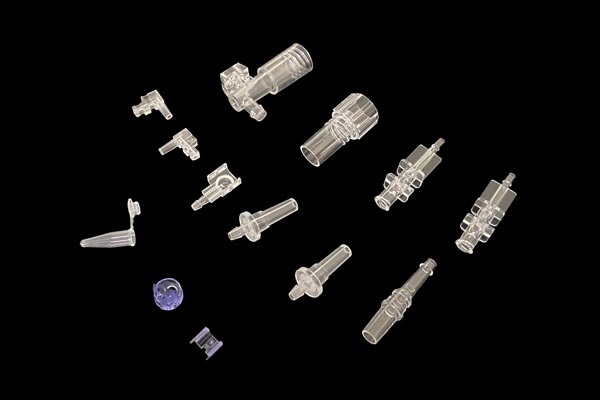
3. Finished Product Performance Testing: Ultimate Validation of Functional Reliability
Mechanical Property Testing
-
Tensile Strength: ISO 527-compliant universal testers measure sample breaking strength (medical-grade PC ≥60MPa).
-
Impact Toughness: Charpy/Izod impact testers evaluate resistance to brittle fracture, with critical components passing -40°C low-temperature tests.
-
Fatigue Life: High-frequency fatigue testers simulate actual usage cycles (≥10⁶ cycles) for dynamic components.
Seal Testing
-
Positive Pressure Test: Infusion sets/syringes are pressurized to 100kPa for 30 seconds, with pressure drop ≤5%.
-
Negative Pressure Test: Vacuum pumps draw to -80kPa to check for deformation/leakage, ensuring compatibility with negative-pressure systems.
-
Helium Mass Spectrometry: For high-precision components (e.g., artificial joints), helium tracer gas detects leaks at 10⁻⁹ Pa·m³/s sensitivity.
Functional Reliability Testing
-
Insertion/Withdrawal Force: Force sensors measure connector operation forces within design ranges (e.g., 2-10N) and lifespan.
-
Rotational Torque: Torque testers verify stability of knobs/valves with ±5% error tolerance.
-
Liquid Flow Rate: Flowmeters measure rates under varying pressures (e.g., 1-20mL/min adjustable) for infusion tubing.
4. Sterilization Compatibility Testing: Safeguarding Aseptic Barriers
Ethylene Oxide (EO) Sterilization
-
Residual Detection: GC per ISO 10993-7 ensures EO ≤4mg/item and 2-chloroethanol ≤9mg/item.
-
Material Aging: Simulated EO cycles (55°C, 60%RH, 6h) test mechanical property changes (≤10% deviation).
Radiation Sterilization (γ/e-beam)
-
Dose Validation: Biological indicators (e.g., G. stearothermophilus spores) confirm minimum dose (typically 25kGy).
-
Yellowing Test: Colorimeters measure ΔE values post-irradiation (medical PC ≤3.0 to avoid visual interference).
Steam Sterilization (121°C/134°C)
-
Thermal Deformation: Saturated steam exposure tests dimensional stability (critical components ≤0.5% deformation).
-
Water Absorption: Gravimetric analysis measures mass change (absorption ≤0.1% to prevent functional failure).
5. Packaging and Transportation Testing: Full-Chain Quality Assurance
Packaging Seal Testing
-
Dye Penetration: Submerged in methylene blue solution under -80kPa vacuum to detect leaks.
-
Bubble Emission: High-voltage discharge detects gas leaks in pre-filled syringe packaging (sensitivity 10⁻⁶ mbar·L/s).
Transport Simulation
-
Vibration Testing: ISTA 3A-compliant random vibration tables simulate road transport (5-200Hz, 2h duration).
-
Drop Testing: Heavy packages (≥10kg) dropped from 1.2m onto concrete (6 faces, 1 drop each) must remain functional.
-
Temperature/Humidity Cycling: -40°C to +70°C, 10%-95%RH cycles (50 iterations) verify packaging material durability.
Conclusion:
Quality control for medical injection-molded components is a systemic endeavor requiring end-to-end lifecycle management. By establishing a closed-loop "prevention-detection-improvement" system and integrating intelligent testing equipment with big data analytics, enterprises can not only meet FDA/CE regulatory demands but also gain competitive differentiation. In an industry where "quality equals life," rigorous testing methods transcend technical requirements—they represent a solemn commitment to human dignity.






 Home
Home