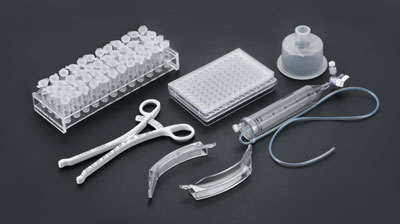
Laryngoscopes, as critical medical devices for observing laryngeal structures, rely on injection molding—a precision manufacturing technique that transforms molten plastic into molds for high-volume production—to ensure clinical safety and effectiveness. This article explores key aspects of laryngoscope injection molding, including material selection, mold design, process parameter optimization, and quality control.
1. Material Selection: Stringent Standards for Medical-Grade Plastics
Laryngoscope components demand materials with biocompatibility, chemical resistance, impact strength, and ease of sterilization. Common choices include:
-
Polycarbonate (PC): High transparency and impact resistance, ideal for observation-related parts (e.g., lens housings).
-
Polypropylene (PP): Chemical-resistant and cost-effective, used for non-critical structural parts.
-
Medical-grade ABS: Balanced performance and ease of processing, suitable for complex components.
-
Polyetheretherketone (PEEK): Premium option with high-temperature resistance and wear durability, albeit costly.
Materials must pass ISO 10993 biocompatibility tests to ensure non-toxicity and hypoallergenicity, complying with medical device regulations.
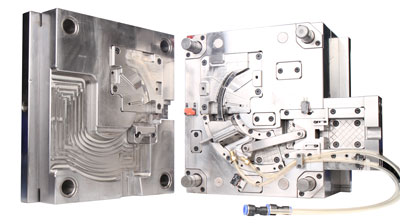
2. Mold Design: Balancing Precision and Functionality
Mold design directly impacts dimensional accuracy and surface quality:
-
Parting Surface Design: Accounts for curved laryngoscope structures to avoid parting lines affecting appearance or function.
-
Gate Position Optimization: Uses mold flow analysis to minimize weld lines and stress concentration.
-
Cooling System Layout: Adopts conformal cooling channels for uniform temperature control and shorter cycle times.
-
Ejection Mechanism Design: Incorporates sliders or lifters for complex features (e.g., snap fits, threads) to prevent deformation.
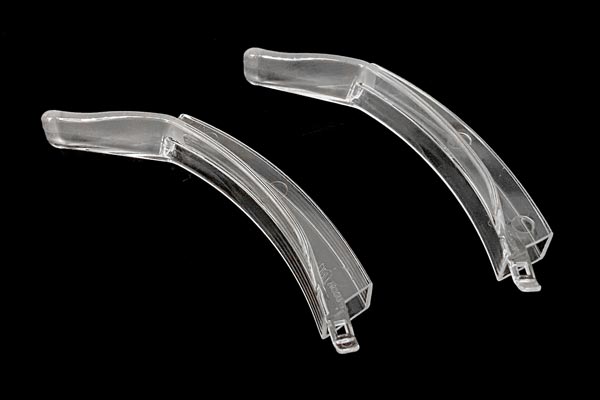
For example, anti-slip textures on handles require etching processes, while lens housing transparency depends on mold polishing precision (Ra ≤ 0.05μm).
3. Process Parameter Optimization: Synergistic Control of Temperature, Pressure, and Time
Critical parameters include:
-
Melt Temperature: PC typically requires 280–320°C; excessive heat causes degradation, while insufficient heat reduces flowability.
-
Injection Pressure: Adjusted based on wall thickness—high pressure (120–180 MPa) for thin-walled parts, low pressure for thick sections to avoid internal stress.
-
Packing Pressure and Time: Prevents sink marks, with packing pressure at 70–80% of injection pressure and duration tailored to material properties.
-
Cooling Time: Balances efficiency and deformation risk, controlled via mold temperature regulators (e.g., 80–100°C for PC).
For instance, lens housing molding demands "high-speed injection + low-pressure packing" to eliminate flow marks in transparent areas.
4. Quality Control: Full-Chain Assurance from Production to Use
-
First-Article Inspection: Uses CMM to verify critical dimensions (e.g., snap-fit clearance, lens mounting hole positions) within ±0.05mm tolerance.
-
In-Process Monitoring: Sensors track injection pressure and melt temperature, with SPC analyzing fluctuation trends.
-
Final Testing:
-
Functional Tests: Simulate clinical use to check snap-fit tightness and rotational component flexibility.
-
Environmental Tests: Subject parts to high-temperature/high-humidity (55°C/95%RH) and low-temperature shock (-40°C) trials.
-
Cleaning Validation: Ensure residuals (e.g., mold release agents) are removable via standard disinfection (e.g., ethanol wiping).
5. Industry Trends and Challenges
Miniaturization and intelligence drive new demands:
-
Micro-Molding: Produces precision parts (e.g., endoscope lens brackets) with injection volumes <1g.
-
Multi-Material Molding: Combines hard and soft materials via two-shot or insert molding for integrated grips.
-
Sustainability: Promotes bio-based plastics (e.g., PLA) and recyclable materials to reduce environmental impact.
Conclusion
The laryngoscope injection molding process integrates material science, mold design, and process control. From rigorous material screening to millimeter-precision mold engineering and dynamic parameter tuning, every step ensures product performance and safety. Future advancements in smart manufacturing will drive efficiency, cost reduction, and eco-friendliness, meeting evolving medical needs.








 Home
Home