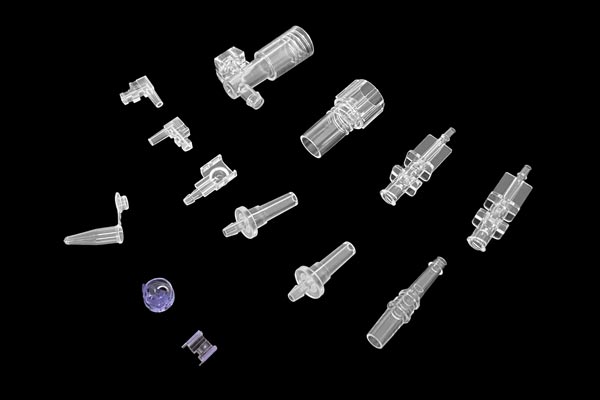
Luer connectors, widely used as standardized connectors in the medical field, have their injection molding quality directly related to the safety and reliability of medical devices. Temperature control is a core factor influencing product performance, appearance quality, and production efficiency during the injection molding process. This article will systematically elaborate on the crucial role of temperature control in the injection molding of Luer connectors from four dimensions: material flowability, product defect control, crystallization behavior regulation, and mold life maintenance.
I. The Decisive Impact of Temperature on Material Flowability
Luer connectors are usually manufactured from high-precision engineering plastics (such as PEEK, PPSU, etc.), which are highly sensitive to temperature. The mold temperature directly determines the flow behavior of the melt in the cavity:
-
High Temperature Promotes Flow: When the mold temperature is at the upper limit of the recommended range for the material, the melt viscosity decreases, and the flowability significantly improves. For example, in the injection molding of PEEK material, when the mold temperature is increased from 120°C to 150°C, the melt flow length can increase by 30%, effectively filling thin-walled structures (such as the 6:100 tapered threads of Luer connectors) and complex geometric features.
-
Low Temperature Leads to Defects: If the mold temperature is lower than the glass transition temperature (Tg) of the material, the melt solidifies rapidly, resulting in defects such as short shots and weld lines. Production data from a medical device enterprise shows that for every 10°C decrease in mold temperature, the product defect rate increases by 15%, mainly due to insufficient filling at the thread roots.
-
Dynamic Balance Control: Through Moldflow simulation optimization, it is found that the optimal molding window for Luer connectors is a mold temperature of 140 - 160°C and a melt temperature of 380 - 400°C. Within this range, the melt maintains good flowability while avoiding material degradation due to excessive temperature.
II. Precise Regulation of Product Defects through Temperature Control
Temperature control is a core means of eliminating common defects in Luer connectors:
-
Warpage Deformation Control: As precision connectors, Luer connectors have extremely high requirements for dimensional stability. By using a zonal PID control technology to set the front mold temperature 2 - 3°C higher than the rear mold temperature, the orientation shrinkage difference can be effectively offset. A case study shows that after adopting this technology, the product warpage is reduced from 0.15mm to 0.05mm, meeting the ISO 594 standard.
-
Internal Stress Elimination: A high-temperature mold can extend the cooling time of the melt and reduce residual stress. Stress tests on PC material show that when the mold temperature is increased from 80°C to 100°C, the surface compressive stress decreases by 40%, significantly reducing the risk of stress cracking.
-
Surface Quality Optimization: For Luer connectors requiring sparkle patterns, the mold temperature needs to be 40°C higher than that for smooth surfaces. By increasing the mold temperature from 60°C to 100°C, one enterprise successfully solved the problem of incomplete texture transfer, reducing the surface roughness Ra value from 3.2μm to 1.6μm.
III. Directional Regulation of Crystallization Behavior through Temperature Control
For semi-crystalline plastics (such as POM, PBT), the mold temperature directly affects the crystallinity and crystal structure:
-
Crystallinity Control: A high-temperature mold (close to the crystallization temperature of the material) can promote the ordered arrangement of molecular chains and improve the mechanical properties of the product. A study shows that when the mold temperature of PBT material is 100°C, the crystallinity is 45%, while when the temperature is reduced to 60°C, the crystallinity drops to 30%, resulting in a 20% decrease in tensile strength.
-
Crystal Morphology Optimization: Through stepped cooling control (high temperature in the front stage and low temperature in the back stage), uniform and fine spherulite structures can be induced. This structure enables the Luer connector to maintain rigidity while increasing the impact strength by 15%.
-
Post-shrinkage Inhibition: Appropriately increasing the mold temperature can reduce post-crystallization shrinkage after demolding. Long-term dimensional stability tests on PP material show that when the mold temperature is increased from 40°C to 80°C, the dimensional change rate after 30 days is reduced from 0.8% to 0.3%.
IV. Maintenance of Mold Life through Temperature Control
Reasonable temperature control can significantly extend the service life of the mold:
-
Thermal Fatigue Suppression: When the mold temperature fluctuates by more than 20°C, thermal cracks are likely to occur on the cavity surface. By controlling the mold temperature fluctuation within ±3°C, one enterprise has extended the mold life from 500,000 cycles to 1.2 million cycles.
-
Corrosion Protection: For glass fiber-reinforced materials, a high-temperature mold can reduce the erosion of the cavity by the melt. Experimental data shows that when the mold temperature is increased from 60°C to 100°C, the wear rate of the cavity decreases by 60%.
-
Cleaning and Maintenance Optimization: A stable high-temperature environment can prevent the condensation of plastics on the cavity surface and reduce the phenomenon of sticking to the mold. A case study shows that by maintaining the mold temperature above the Tg of the material by 5°C, the cleaning cycle is extended from once per shift to once per day.
V. Application Trends of Intelligent Temperature Control Systems
With the development of Industry 4.0, the temperature control in the injection molding of Luer connectors shows the following trends:
-
Independent Control of Multiple Zones: The combination of electric heating tubes and mold temperature controllers is used to achieve differentiated temperature control in areas such as the core, cavity, and gate, with an accuracy of ±1°C.
-
Real-time Monitoring and Feedback: An array of thermocouples is implanted in the cavity, and combined with machine learning algorithms, the temperature parameters are dynamically adjusted. After applying this technology, one enterprise has improved product consistency by 30% and reduced mold change time by 40%.
-
Sustainable Temperature Control Solutions: High-temperature water temperature controllers (with an outlet temperature ≥160°C) are developed to replace heat transfer oil with water, reducing energy consumption by 30% while eliminating the risk of oil leakage.
Conclusion
Temperature control in the injection molding process of Luer connectors serves as a bridge connecting material properties, mold design, and product quality. By precisely controlling the mold temperature (usually within the range from the Tg to the crystallization temperature of the material), the melt temperature (close to the lower limit of the material decomposition temperature), and the cooling rate, the material flowability, product defect rate, crystallization behavior, and mold life can be synergistically optimized. With the development of intelligent temperature control technology, the injection molding of Luer connectors will evolve towards higher precision, higher efficiency, and greater sustainability in the future, providing a solid guarantee for the precision manufacturing of medical devices.






 Home
Home